Tutorial
AI Blogging: Turn a Generic Draft Into an Article Worth Citing
Improve an AI blog draft with a worked before-and-after edit, a claim ledger, and a source packet that turns broad SEO advice into a useful publishing decision.
 By Abhi Bavishi, , 10 min read
“AI agents can streamline SEO, uncover opportunities, and improve performance.”
That sentence could introduce almost any article about AI marketing. It makes no decision easier, names no evidence, and gives another writer nothing specific to cite. Adding a customer persona or changing the tone will not fix the missing substance.
The editorial job is to replace broad benefits with an answer that survives inspection. Here is a worked example for a question RankParse readers actually face: can an assistant investigate why a page lost clicks?
What current adoption data tells an editor
In Ahrefs' September 30, 2026 survey, 280 of 301 respondents (93%) said they use AI to create or help create content. This is a survey of those respondents, not a census of every marketer or every published page. Ahrefs' 2026 content-creation survey
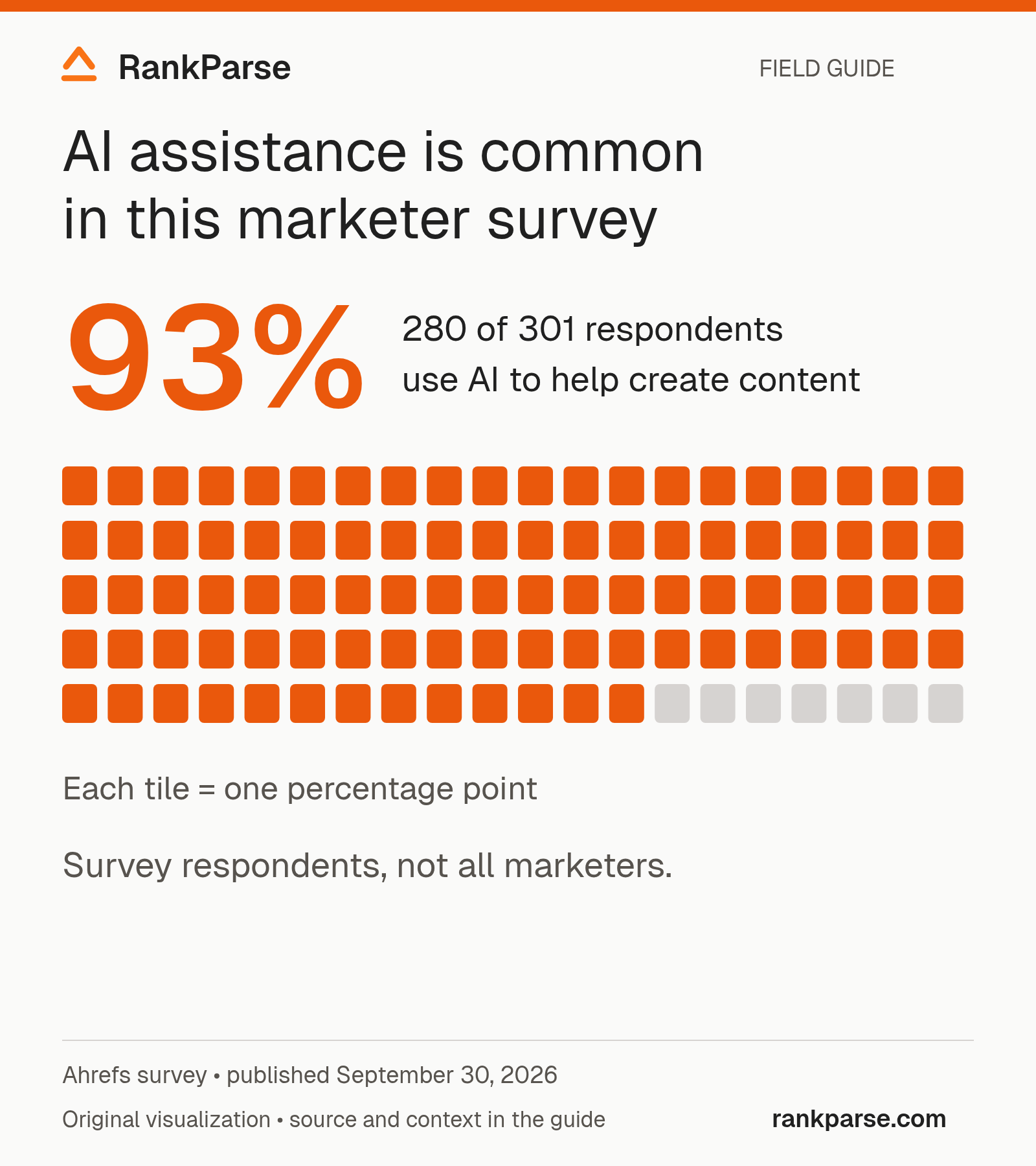
Download the source notes and calculation inputs (CSV).
The finding gives an editor a useful strategic question: if AI assistance is common in this sample, what will make our article distinctive? Tool access alone is unlikely to answer that question. Our practical response is to invest in the source packet, specialist input, and examples the draft depends on. That is an editorial recommendation, not a causal conclusion from the survey.
Start with a draft that sounds finished
Consider this deliberately constructed draft paragraph:
Connect an SEO MCP server to your AI assistant to get real-time data. It can analyze declining traffic, identify the cause, and tell you exactly what to fix. Automating the process helps teams improve rankings faster.
It reads smoothly. It also bundles several different claims into one promise.
| Draft claim | Evidence it needs | Editorial decision |
|---|---|---|
| “Real-time data” | The freshness of the particular dataset being used | Name the dataset and its date or retrieval behavior |
| “Analyze declining traffic” | Access to the relevant site's performance data | State the required account connection or export |
| “Identify the cause” | Evidence distinguishing plausible explanations | Describe an investigation rather than promise a causal diagnosis |
| “Improve rankings faster” | A defined comparison and measured outcome | Remove it when no such result exists |
This table is a claim ledger. It makes the revision assignable: the editor knows which fact to retrieve, which condition to add, and which sentence to remove.
Replace the promise with a specific decision
For RankParse, a defensible version reads:
To investigate a page's lost clicks, give the assistant comparable Search Console page and query data, then inspect the current page. RankParse's API-key MCP endpoint can access Search Console after the integration is connected; the browser OAuth connector requires you to supply that performance evidence separately. Use the assistant to distinguish a change in impressions, click-through rate, or query mix, and select the next check. A page audit alone cannot establish why traffic changed.
The access claims are documented in RankParse's MCP guide. The paragraph is a worked editorial rewrite, not a transcript of a live test.
The improvement is not a more emphatic adjective. It is a reader now knowing what to connect, what evidence to provide, and what conclusion the workflow can support.
Give the article something another publisher can reference
A useful contribution does not always require a large survey. It does require something more specific than an instruction to “use AI responsibly.”
For this traffic-investigation article, the contribution could be a decision table:
| Comparable observation | Next question | Evidence to inspect |
|---|---|---|
| Impressions fell and position changed | Which established queries lost visibility? | Query and page segments with the same filters |
| Impressions held steady but clicks fell | Did click-through rate or the query mix change? | Segmented CTR, page promise, and dated search-result observations |
| Overall position worsened while impressions rose | Is the page appearing for additional queries? | Existing-query and new-query groups |
| The page redirects to a different URL | Was that redirect intended? | Current response, destination, and migration history |
Each row gives the reader a next action. None pretends that a single metric proves the cause.
A technical tutorial could contribute a reproducible failure case instead. A comparison could contribute a task-based access matrix. A statistics article could contribute a downloadable dataset with dates and definitions. Choose the contribution before asking for a longer draft.
Assemble the source packet around claims
Give the assistant the exact reader question, the primary documents, and the original material the article will add. Keep evidence and editorial intention in separate columns:
| Claim ID | Proposed claim | Source or observation | Scope | Status |
|---|---|---|---|---|
| C1 | This connector can read Search Console | Endpoint documentation | Specific connection route and required integration | Verify before drafting |
| C2 | Clicks fell during the comparison period | Authorized report | Property, dates, country, device, and search type | Await report |
| C3 | The workflow produced a ranking gain | Controlled measurement | Defined outcome and comparison | Remove unless supported |
These rows are a blank assignment example, not findings about an account. Download the claim-ledger template and replace them with your own claims.
For statistics, preserve the sample and question wording beside the percentage. “Tried an agent” and “runs an agent in production” describe different behavior. For a product tutorial, preserve the connection route and version. A correct instruction for one setup can be unusable in another.
Commission the draft after the gaps are visible
Try this prompt
Draft from a claim ledger
Replace placeholders and attach the inputs described above. Paste the prompt if your assistant opens an empty chat.
Need the tools? Add RankParse to Claude · ChatGPT setup
Review factual claims before polishing the prose. Then review the title, description, and structured data against the finished body: a careful article can still be misrepresented by an exaggerated headline. Google explicitly includes metadata in its accuracy-review guidance for AI-generated content. Google's AI-content guidance
If the assignment is to refresh an existing article, use the content-refresh brief to preserve useful sections rather than replacing everything.
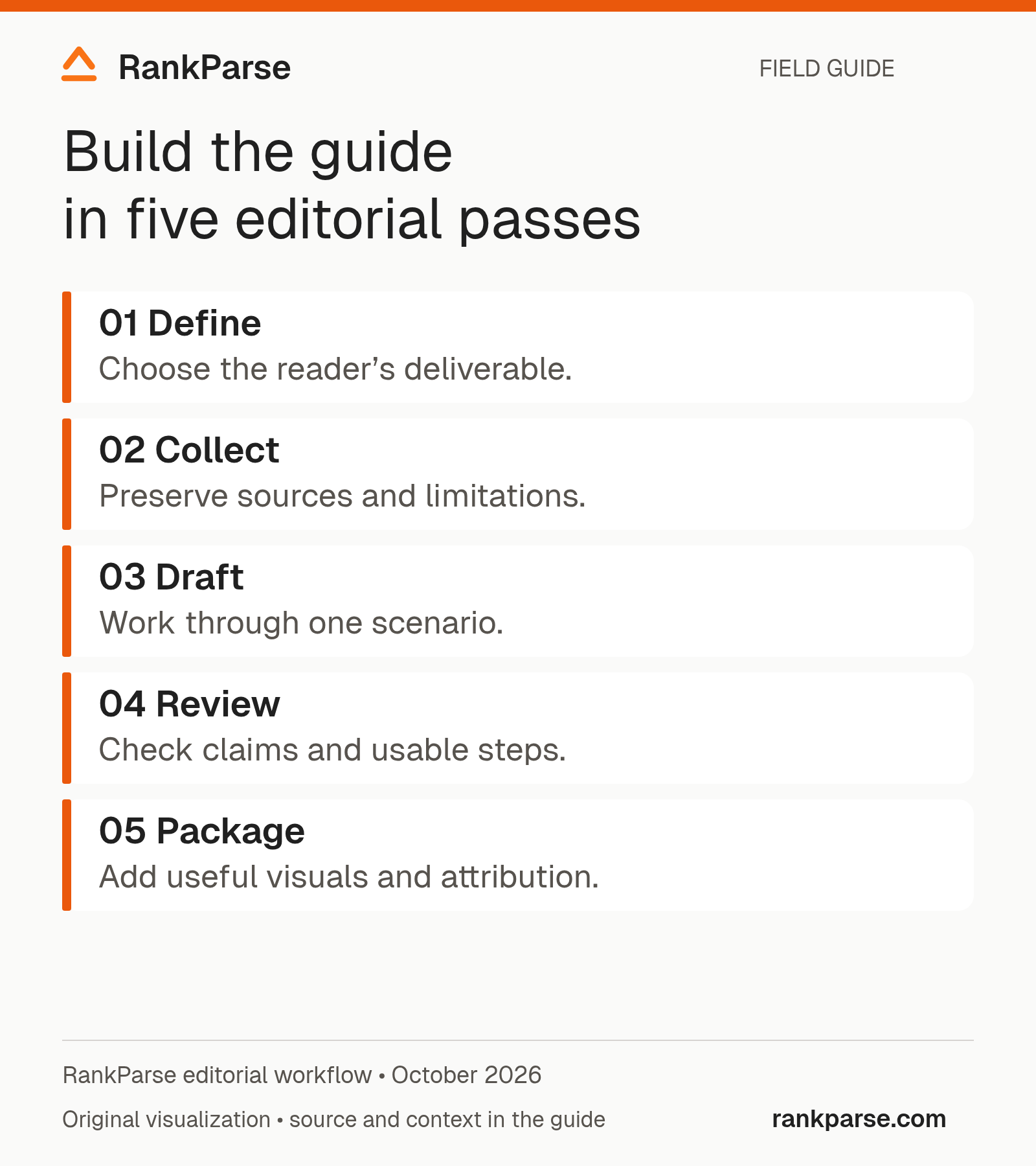
Build the article in five passes
Treat each pass as a different job. Asking the assistant to research, invent examples, write, fact-check, and approve the same output in one instruction makes unresolved gaps hard to see.
1. Define the deliverable before the outline
For the traffic-investigation guide, the deliverable is a decision table that helps someone choose the next check after clicks fall. It is not “a comprehensive guide to SEO agents.” Write down the inputs the reader needs and the output they should leave with.
A useful outline follows that job: establish comparable data, identify the changed metric, check the relevant segment, inspect the page, then assign the next investigation. A generic history of AI adds little to this reader's task. Background belongs only where it resolves a real misunderstanding.
2. Collect evidence with its limitations intact
Save the source URL, retrieval date, and relevant passage or observation. For a product behavior, record which connection or version it describes. For a calculation, keep the input rows. For an expert contribution, retain the reviewed explanation and permission to publish any identifiable details.
Keep research notes separate from instructions. A source can tell you how a tool behaves; it cannot decide the business priority for your reader. Ask the assistant to flag disagreements between sources and preserve unknowns. Do not let it silently choose whichever statement makes the narrative smoother.
3. Draft around a worked example
Use one scenario all the way through the article. If the opening promises to investigate a page's lost clicks, the example should show the data needed, the observation, and the next decision. Switching to unrelated examples in every section forces readers to reconstruct the workflow themselves.
A fictional scenario is useful when it teaches a method and is clearly labelled. An invented customer success story is different: it implies observed performance that does not exist. Keep demonstration numbers out of headlines that could be mistaken for measured results.
4. Review claims and instructions separately
A sentence can be factually correct but operationally incomplete. “Use Search Console data” is reasonable advice, yet a reader still needs the right property, comparable filters, and the correct connection route. Review whether someone could carry out the procedure with the prerequisites you have named.
Then inspect each strong verb. “Proves,” “causes,” “guarantees,” and “fixes” require more support than “suggests” or “identifies a candidate explanation.” Do not simply weaken every sentence. Obtain stronger evidence when the claim is important; otherwise state the narrower conclusion precisely.
5. Package the answer for reading and reuse
Give each substantial visual one job. A comparison chart explains a difference. A workflow shows order and handoffs. An annotated example shows how to apply a rule. Place the visual immediately after the question or claim it explains, then discuss its implication below it.
Use descriptive filenames and alt text that communicates the key result. For the adoption chart, the alt text should identify 280 of 301 survey respondents and the date, not merely say “AI statistics infographic.” Keep the source visible in the image and linked in the caption. That attribution should survive when someone downloads the graphic.
Measure the editorial process before claiming SEO impact
Track the work you can actually observe. A small team might record research time, editing time, unresolved claims at review, corrections after publication, and whether the promised deliverable was completed. Define the fields consistently before comparing articles.
For example, an illustrative production log could distinguish an unsupported product claim from a spelling correction. Combining both into a single “edits required” count hides the difference between accuracy work and polish. Likewise, a draft written quickly may still require substantial expert review before it is ready.
If you compare AI-assisted and other workflows, account for assignment difficulty, author experience, and available source material. Without that context, a time difference tells you little about which process is better. Keep process measurements separate from traffic changes, which have many possible causes.
A handoff checklist for the editor
Before approving the page, confirm that the opening answers the reader's question, every consequential claim has support, the worked example reaches a useful decision, and the instructions name their dependencies. Check that the image captions, alt text, title, and description do not overstate the body.
Assign an owner for future updates. Product access rules and documentation change; a useful tutorial needs someone to revisit those dependencies. A precise guide that is maintained can remain useful long after a generic “latest AI trends” article has lost its reason to exist.
The edit that matters
Take the broadest promise in your next AI draft and split it into testable claims. Find the dependency the paragraph hides: a connected account, a current observation, an expert explanation, or an experiment that has not happened.
Write the article around resolving that dependency. In the example above, the result is a practical traffic-investigation guide with an access requirement and a decision table. It gives readers a reason to keep the page open after the first paragraph.
Sources checked October 20, 2026. The before-and-after paragraph and worksheets are constructed editorial examples.
 Add to Claude