Explainer
Google AI Content Rules in 2026: The Changes That Matter
Read Google's 2026 AI content changes through a dated policy timeline, a worked publishing example, and a practical way to decide which pages deserve to exist.
 By Abhi Bavishi, Updated , 9 min read
An AI-assisted blog can pass a fact check and still give readers no reason to choose it. That is the publishing problem worth examining in Google's current guidance: accuracy matters, but so does what a page contributes.
For an SEO team, the useful question is whether its publishing process produces distinct answers or simply more URLs. A prompt that generates a different title for every keyword has not answered that question.
Our reading of Google's 2026 documentation is that publishers should evaluate the value of each proposed page before scaling production. Here is the evidence behind that interpretation, and what it changes in an actual editorial plan.
Two documented changes to keep separate
| Date | What Google recorded | Editorial consequence |
|---|---|---|
| May 15, 2026 | Clarified that its spam policies also apply to generative AI responses in Search | Treat attempts to manipulate AI answers as part of the same policy review as conventional search |
| October 1, 2026 | Added information from the Search Quality Raters guidelines to its generative AI content guide | Review the page's originality and usefulness alongside its factual accuracy |
These entries come from Google's documentation changelog. The October entry says the change aligns documentation with developer-event presentations. Neither entry, by itself, announces a new ranking-system rollout or explains a particular site's traffic decline.
The current AI-content guide points to rater sections 4.6.5, covering scaled content abuse, and 4.6.6, covering content made with little effort, originality, or added value. Google also says rater assessments do not directly affect rankings. Those sections are evaluation context, not a ranking formula. Google's AI-content guidance
What Google's 45% figure actually measures
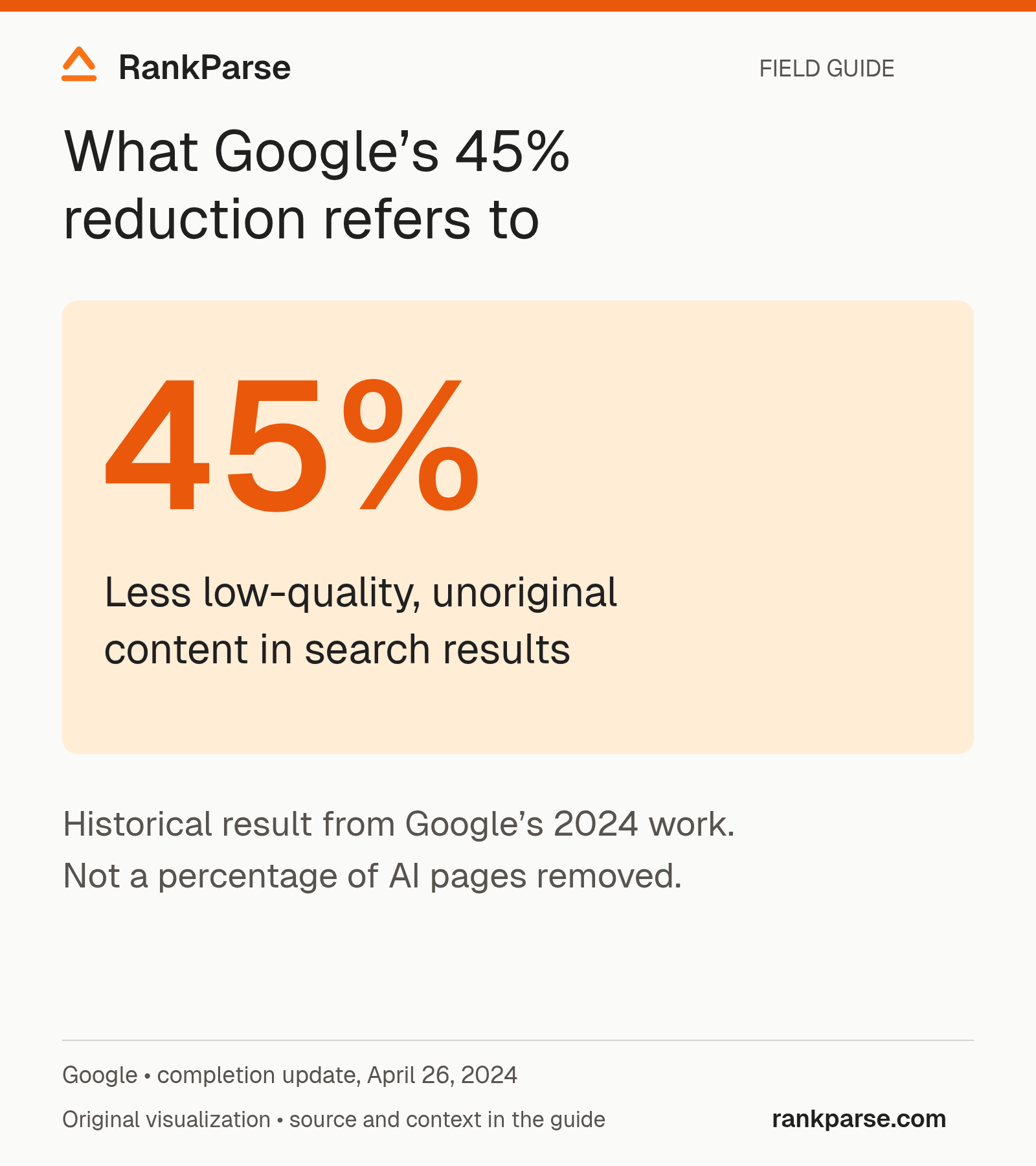
Google reported a 45% reduction in low-quality, unoriginal content in search results after its March 2024 work, updating its earlier 40% expectation on April 26, 2024. This is historical context for the policy discussion, not a new October 2026 measurement. Google's announcement and completion update
It is not a claim that 45% of AI articles were removed, or that an individual publisher should expect a 45% traffic loss. The population and outcome matter. Replacing “low-quality, unoriginal content in search results” with “AI websites” creates a different statistic that the source does not supply.
Download the source notes and calculation inputs (CSV).
When a statistic appears in an editorial brief, make the editor write its denominator in plain language. Ask what was measured, when, by whom, and whether the observation was a forecast or a reported result. If those fields are missing, hold the graphic. A large percentage with an ambiguous label can spread a false interpretation faster than a paragraph can correct it.
A factually correct page can still have no reason to exist
Imagine a payroll software company planning these three articles:
- How to migrate payroll data.
- How to move payroll records to new software.
- How to transfer employee payroll information.
Different wording does not establish three different reader tasks. If all three explain exporting a CSV, uploading it, and checking the result, the editorial team has split one answer across three URLs.
Now consider three genuinely different assignments:
| Proposed page | Distinct decision | Material the author must obtain |
|---|---|---|
| Migrate payroll mid-year | How should opening balances be reconciled? | A reviewed reconciliation example and responsibility checklist |
| Migrate from a named payroll tool | Which source fields map to which destination fields? | Actual export headers and documented import requirements |
| Recover from a failed payroll import | How can the team repair a partial import without duplicating records? | Tested failure cases, rollback behavior, and support guidance |
This fictional plan illustrates our editorial test: if the title changes, does the evidence required to answer it change too?
If it does, a separate page may have a clear purpose. If the writer can reuse the same body after replacing a few phrases, consolidate the assignment before drafting. This is a planning heuristic, not a Google rule requiring a particular number of pages.
Google's scaled-content policy focuses on producing many pages primarily to manipulate rankings without helping users. Its examples include AI generation without added value and assembling material from other sources without a useful contribution. Human involvement does not exempt a process from that policy. Scaled content abuse
Replace the keyword brief with an evidence brief
A weak assignment says: “Target payroll migration, include these headings, and make the article comprehensive.” It gives the writer a shape, but no new knowledge.
A more useful assignment says: “Explain how a finance manager reconciles opening balances during a mid-year migration. Use the reviewed example supplied by our payroll specialist. Identify who signs off each check and what happens when totals disagree.”
The second assignment is harder to automate end to end because someone has to obtain the example. That work is also what makes the article useful.
Before commissioning a batch, ask editors to fill in three fields for each proposed URL:
- Decision: what can the reader decide or complete after reading?
- Contribution: which example, observation, comparison, or explanation is ours to add?
- Dependency: what evidence must arrive before the draft can be written?
An empty dependency field is worth discussing. It may mean the assignment is already fully supported. It may also mean nobody has asked what the author needs to learn.
Separate editorial problems from technical problems
A page audit can identify a missing description or an unexpected canonical. It cannot determine whether your payroll example is correct or whether a second article duplicates the first one's purpose.
Use RankParse's page SEO check to inspect the published page's technical presentation. Read the full article and its source material to evaluate the answer. If performance is part of the investigation, use connected Search Console data through the appropriate API-key setup or provide an approved export to your web assistant. The MCP documentation explains that access distinction.
Keep these diagnoses separate when assigning work:
| Finding | Appropriate response |
|---|---|
| Two pages answer the same question with the same evidence | Review their distinct purposes before deciding whether to combine them |
| A useful guide contains an obsolete product instruction | Correct the instruction and record the substantive revision |
| An article has an unintended noindex instruction | Investigate the technical configuration |
| Traffic fell near a documentation change | Examine affected queries, demand, technical changes, and timing |
The last row matters. “Google detected our AI writing” is not a conclusion supplied by a traffic chart. The traffic-drop diagnosis guide covers the evidence needed for that investigation.
Run a page-by-page contribution audit
Start with a manageable group of articles that share a reader task. For the fictional payroll company, review the migration cluster together. An isolated page may appear useful until you see that three neighboring pages give the same answer.
Build a worksheet with the URL, reader task, distinctive evidence, last substantive verification, overlapping pages, and next decision. Add business context such as who uses the guide and what a successful visit looks like. A product-support article may serve an important purpose even if it attracts little search traffic.
Read the pages before assigning actions. The following are editorial recommendations, not an automated Google quality score:
| What you find | What to inspect next | Possible editorial action |
|---|---|---|
| A useful answer with an outdated procedure | Which step changed and who owns the current procedure? | Update the step and validate the worked example |
| Several articles with the same decision and evidence | Does any page serve a separate audience or scenario? | Consolidate overlapping material after reviewing URL dependencies |
| A strong claim with no traceable support | Is evidence available from a primary source or specialist? | Obtain support, narrow the claim, or remove it |
| A thin page with a legitimate task | What is missing for the reader to finish that task? | Add the necessary example, constraints, or troubleshooting |
| A page with neither a useful purpose nor a business requirement | Are there links, users, or historical references to preserve? | Review retirement with the site owner |
Do not mass-delete articles solely because an AI tool helped write them. Also avoid rewriting everything at once: you lose the ability to distinguish a useful correction from a cosmetic change. Record the reason for each revision and the evidence that made it necessary.
Put a release gate between generation and publication
A team can use AI to outline, summarize supplied material, or suggest missing questions while still making an editor responsible for the final page. The important handoff is the one between a plausible draft and a publishable answer.
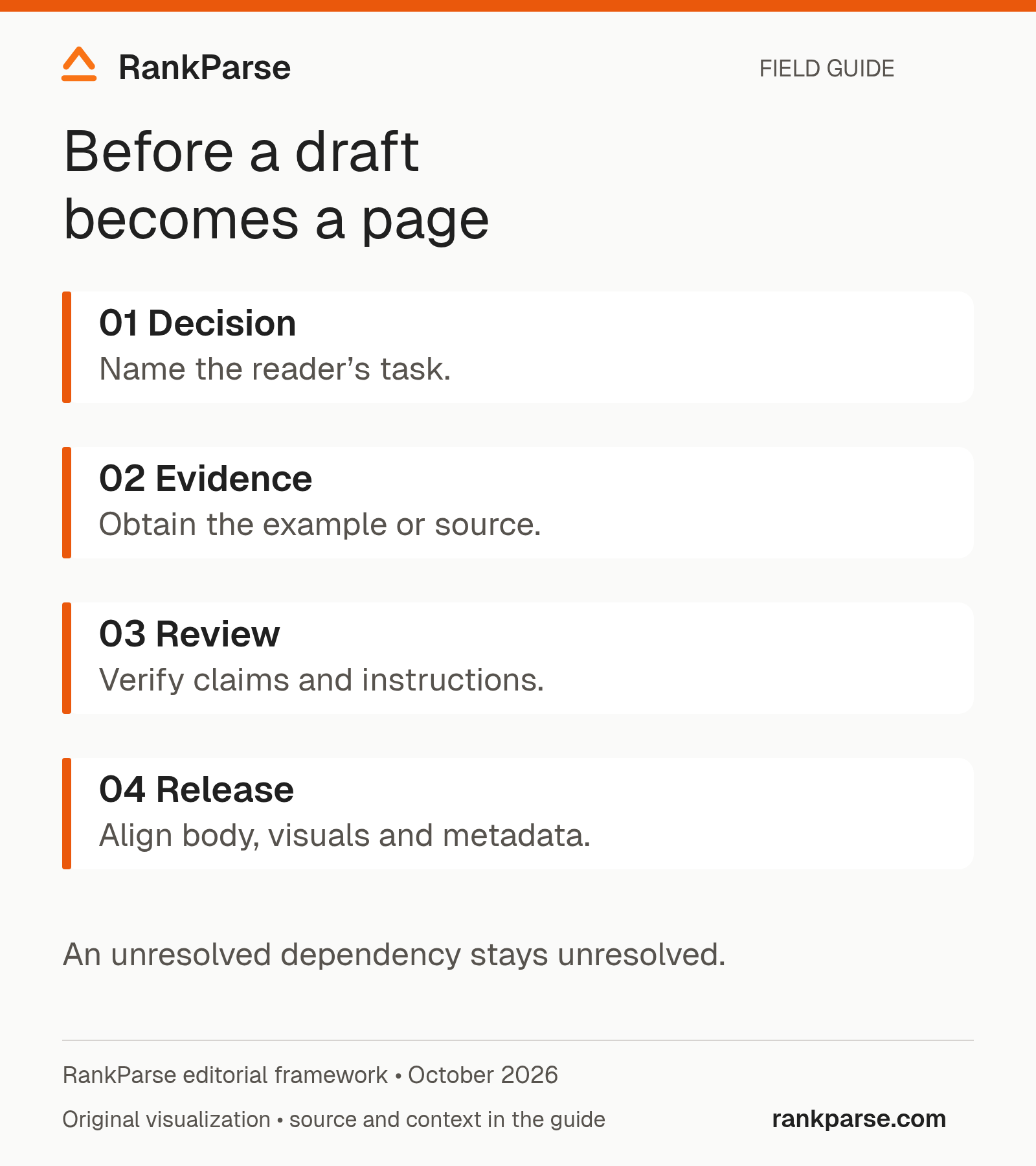
For the payroll article, the first gate is a clear reader decision: reconcile opening balances before completing a migration. The evidence gate requires an approved example. The review gate requires someone qualified to verify the procedure. The publishing gate checks that the title, body, metadata, and visuals describe the same scope.
If the specialist has not reviewed the example, mark that dependency unresolved. A model saying that the steps “look correct” does not close it. If a graphic illustrates a fictional balance reconciliation, label it as fictional inside the image as well as in its caption. The image may circulate without the rest of the article.
After publication, keep a short change log. Record what changed, when it changed, and why. Monitor the page's relevant query and user behavior, but do not declare a recovery from one favorable day. Choose comparison periods that reflect the page's traffic volume and seasonality; there is no universal waiting period that proves success.
Questions an editorial lead should answer
Does every article need original research? No. A reproducible procedure, a carefully explained trade-off, or a specialist-reviewed example can be a useful contribution. The test is whether the reader gains something beyond a rearrangement of the pages already available.
Does adding a chart make a weak article valuable? Only when the chart explains evidence or makes a decision easier. A decorative percentage with no source, or a flowchart that repeats headings, does not resolve a thin assignment.
Should the team optimize for a minimum word count? Write enough to complete the task and handle its important exceptions. Expand an article when the explanation is incomplete. Remove sections that do not help the intended reader, even if that makes the page shorter.
What to change in the next publishing meeting
Take the next batch of proposed articles and add the decision, contribution, and dependency fields. Review them before approving titles.
For the payroll example, that meeting should end with an owner for the reconciliation example, access to real export requirements, and a decision about overlapping URLs. Those are concrete editorial commitments. “Make it more human” is not.
Primary sources checked October 20, 2026. The payroll scenarios are illustrative; the planning recommendations are RankParse's interpretation of the documented guidance.
 Add to Claude